Pocket Rocket v2 Review: Why I'm Keeping the 3.6m and Sold the 2.4m

Intro:
I had high expectations for the Pocket Rocket v2. Over the past year, I've consistently recommended the original Pocket Rocket as my favorite parawing. I expected the v2 to be an easy upgrade. Instead, after riding the 3.6m and 2.4m in the Columbia River Gorge, I came away with two completely different opinions. The 3.6m has become one of my favorite parawings I've ever ridden, while the 2.4m won't be staying in my quiver. Here's what I found, what changed from the v1, and why my recommendations differ so dramatically between the two sizes.

The sizes I ordered and why:
For the v2 I decided to go with the 3.6m and 2.4m. My size choices were based entirely on my experience with the v1. The v1 3m lacked just a tiny bit of grunt in conditions that I think would have been fun if I could have gotten on foil. The v1 2.4m didn't give me a huge increase in range over the top end of the v1 3m, but was my all time favorite size to ride. So, I got the new 2.4m to replace my previous favorite and the 3.6m so I could get up in any Gorge condition worth riding.
Rider Data, Gear and Style:
Sizes tested: 2.4m and 3.6m.
Wind range tested: 20-35 knots of west winds.
Boards used in this review:
Foils used in this review:
AFS Silk v1-2. Enduro 800
Lift Florence 110x, Vario 120
Code 720s
Masts used in this review:
AFS 80 UHM and 80 Skinny UHM
One Ocean 78sss v2
Accessories used in this review:
Stash belt v2
Mission pack.
Rigid monoloop.
Mystic harness.
What's New in the Pocket Rocket v2:
The lines are stiffer:
This is one of the most significant changes from v1 to v2. I personally loved the soft lines that were on the v1s. They were very easy to manipulate, stow, and super soft on my hands. The biggest downside was that many people struggled with tangling them. With experience, line management becomes easier, but most riders prefer equipment that minimizes the learning curve. The v2 addresses this. After countless sessions and intentional abuse the v2 lines have failed to tangle on themselves. The knots, tangles, and rat's nests are essentially gone. Ozone did an excellent job stiffening the lines while still keeping them as soft to the touch as possible. The only negative here is that the stiff lines will require a slightly different packing technique. The new lines simply don't like to roll into the canopy as well as the old ones did. IMO this tradeoff is worth it for a vast majority of riders.
Stow and Redeploy:
I had to be careful with the v1 when stowing and redeploying. The v2? Not so much. It's incredibly user friendly and welcomes fast packing and wild redeploys.
Reinforcements:
My only significant complaint about the v1 was that the edges had a tendency to tear. They have been reinforced on the v2 and this model looks like it will last multiple seasons without issue.
Center front bridle line risers:
The v2 has the central A lines clustered together into an easy to grab set. This makes retraction under power extremely easy. I still prefer to grab all of the A lines whenever possible for an easier stow (no ears to collect) but this works very well.
Line length:
My wingspan is 68" (173cm) fingertip to fingertip and I have no issues retracting the v2 2.4m or 3.6m via the A lines.
3.6m Bar to Batten A-Line retract length: 56" (142cm) (I never had a v1 to measure). This is about the longest I would want to own for myself. At this line length if you leave the lines hanging they aren't likely to tangle, but they can commonly loop over the nose of your board while riding which can lead to frustration.
2.4m Bar to Batten A-line retract length: 47" (119cm) which is 1" shorter than the v1.
Color coding:
One change from v1 to v2 that I'm not a fan of is the monotone color for left side and right side wing tips. When retracting and gathering the battens in a concertina I found the different colored tips of the v1 to be useful for a fast, organized, pack away because it was so easy to identify the different ends of the parawing. With both sides being the same color, keeping things organized is a little less user friendly now.
Upwind Angles and Speed:

The 3.6m had similar upwind angles to my v1s. Maybe just a touch lower in comparison to my 3m v1. However, when the 3.6m v2 was in its sweet spot, around 24-25 knots it was very fast upwind. I consistently clipped upwind at 16-18mph which is far faster than my normal upwind pace. You do lose this speed benefit when you get overpowered and my pace dropped to around 11mph when winds were 30+ knots. This just tells me that the published wind range is where the 3.6m will shine.
Wind Range:


3.6m
The published range is about 17-27 knots and my first session was in exactly that wind range. This size was perfect. I never had to wait excessively to get on foil and I never felt over powered. The 3.6m reacts naturally and moves intuitively through gybes in light or strong winds.
Top end: I've repeatedly pushed this size a bit over 30 knots. The great thing about the 3.6m is that it maintains perfect composure as the wind increases. The wingtips never collapse and the 3.6m holds its position in the wind window while it drives upwind. The central A line collapse was required for me at these wind speeds and works great. When I reach the absolute max wind limit on this size (around 33 knots if the gauges are to be trusted) I'm typically pulled off my board when trying to go upwind. Not launched, it doesn't feel sketchy, but I am firmly escorted into the air.
2.4m
On my first day with the v2's I wanted to see if I could bridge the gap from the 3.6m to the 2.4m. When I felt the first tiniest whisper of discomfort I sat down in the water and pulled the 2.4m out of the mission pack. I'm very pleased to say there was just enough wind to get going which made skipping the 3m a reasonable decision for me.
Why the 2.4m Didn't Work for Me
As someone who primarily rides high-wind Gorge conditions, small parawings are the most important part of my quiver. Because of that, I have very little tolerance for instability or compromised upwind performance in a high wind wing.
The 2.4m has a published range of about 23-39 knots. My problems began right in the middle of that range when gusts started to exceed 30 knots. I struggled to track upwind as the 2.4m wouldn't stay calm in the wind window. At 35 knots, still well below the max published range, it became difficult enough to control that I stopped riding it. At that point it began oscillating vertically in the wind window resulting in uncontrolled crashes that ripped me off my board. I also tried the 2.4m with three different foil setups in case the behavior was somehow equipment-related, but experienced the same instability across all of them. This video of the 1.9m Power Pack illustrates the type of oscillation I experienced. The sequence from 1:05 to 1:25 flipped foil and all, is exactly what was happening to me when the wind was gusting to 35 knots:
Conversely, the v1 2.4m was reliable in winds as light as 27 knots and as high as 45 knots. When maxed out it never felt out of control, it just wasn't comfortable to ride any longer.
Out of an abundance of caution, I emailed Ozone on June 10th sharing my concerns and asking if they were aware of any issues with the 2.4m. I waited 2+ weeks before publishing and I have not received a response. If I do hear from them, I will update this post.
Over the past few weeks I started to notice a few other comments questioning the smaller v2 sizes online in forums. I also saw that some experienced riders were back on the v1 small sizes. After seeing that, and hearing the following report from another local rider...
"Used the 2.4 tonight at Arlington. Had a tough time going up wind, yanked off the board more than a few times. Really squirrelly, due to the lower aspect ratio? Went in and swapped for my V1 2.4. No problem. More comfortable, wing parked up in the window, better angles upwind, etc. Not sure I'll be moving off V1s."
(I was on the water using the 777 2.4m PT Skin at the same time as he was with no issues)
...those reports and observations matched with my own experiences were enough for me to move to another brand for my small high wind parawings.
Build Quality:
Paint Splatter
Both of my v2s as well as my friends v2s have red paint splattered on the white canopy sections. This appears to be from the red A lines as my canopy looks like it had spaghetti noodles spilled on it.

Messy Splices
Some of the line splices on mine left tails hanging out. This leaves the lines looking frayed and damaged to anyone who doesn't know how splices work and how to clean them up.
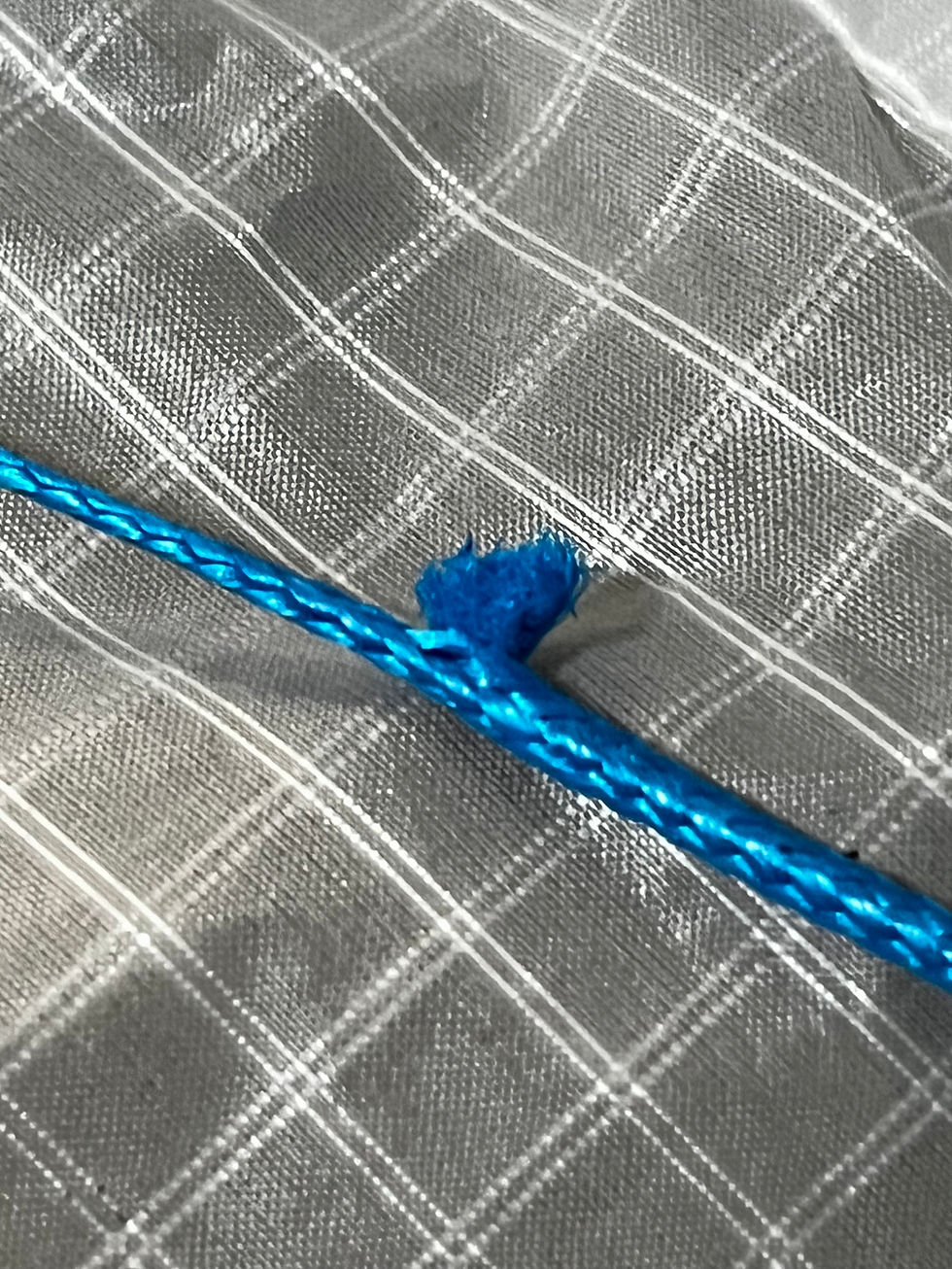
Both of those issues are purely aesthetic in my opinion. Disappointing but not a deal breaker.
Slick Bar
I have had a tough time getting my harness line to stay in place on the v2 bar. It keeps rotating around into the bridle side. The rotation is causing wear and tear on the bar which will result in it aging poorly unless I figure out a new harness line.
Final Thoughts and Recommendations:
The 3.6m exceeded my expectations. I highly recommend it and I have gotten far more use out of it than I ever would have expected. I would definitely consider adding a 4.3 or 5 to my quiver if I got into light wind riding.
The 2.4m was not right for me. I hope that riders in other locations, on different foils, or with different riding styles get along better with it. If possible, I'd strongly recommend demoing that size before buying.
It's worth noting that my concerns were limited entirely to the 2.4m. Nothing about my experience with the 3.6m suggested a broader issue with the larger sizes.
Thank You:
Thanks for reading! If you have any questions about the Pocket Rocket v2, feel free to leave a comment and I'll do my best to answer. Thanks again to Christian at Poseidon Standup for getting me on these as well as for the great sales and customer service!
See you at the river,
Bryan Lee, M.S. Experiential Education.


What did you replace the 2.4m with?
Thank you for the review Bryan!